Pumping out a basement is the easy part to start and the hard part to finish. Hooksett's town ordinance bars placing snow, ice or pumped water on the traveled part of a public way or sidewalk without written permission, and the sewer ordinances close off the sanitary sewer as a place to send it.
Key takeaways
- The town ordinance bars placing snow, ice or pumped water on the traveled part of a public way or sidewalk without written permission.
- The sewer ordinances bar sending stormwater, groundwater or subsurface drainage into the sanitary sewer.
- Roof downspouts, foundation drains, areaway drains and floor drains cannot connect to a building sewer that leads to the public sewer.
- Floor drains may not be connected where they sit below the 100 year flood elevation, and a drain too low for gravity must be lifted by an approved means.
- An extraction crew plans where the hose ends before the pump starts.
Two rules that shape where pumped water goes
Pumping looks simple, but the water has to end up somewhere. Two sets of rules narrow the choices: one for public streets and one for the sanitary sewer.
- The town ordinance bars placing snow, ice or pumped water on the traveled part of a public way or sidewalk without written permission.
- The sewer ordinances bar sending stormwater, groundwater or subsurface drainage into the sanitary sewer.
Why the sanitary sewer is off limits
The sewer ordinances bar connecting roof downspouts, foundation drains, areaway drains, floor drains or other runoff or groundwater sources to a building sewer that leads to the public sewer.
Sanitary sewers are meant for household waste. Pumped basement water is groundwater or stormwater, and it belongs on the ground outside the building instead.
What this means for a homeowner with a pump
A homeowner who starts pumping a flooded basement needs a discharge point on the owner's own property, not across a sidewalk and not into a drain.
The Hooksett water damage pros can help pick a safe discharge spot before the pump starts, and a full basement flooding cleanup follows once the water is out.
- Run the hose to open ground on the owner's own lot.
- Point the discharge away from the foundation so it does not return.
- Keep water off sidewalks and the traveled way.
- In freezing weather, remember that pumped water can turn to ice on walking surfaces.
- Never connect the hose to a floor drain, a sink or a toilet.
Winter pumping, snow and ice
The ordinance names snow and ice along with pumped water, and the reason shows in winter. Water discharged onto a walkway or the road can freeze into a slick surface overnight.
A winter pump out therefore needs a discharge point on open ground, with the hose end moved or protected so it does not freeze shut.
- Keep the discharge off steps, walks and the road.
- Protect the hose end from freezing shut.
- Clear snow from the discharge area before pumping.
- Watch for ice forming where the discharge reaches the ground.
How an extraction crew plans the discharge
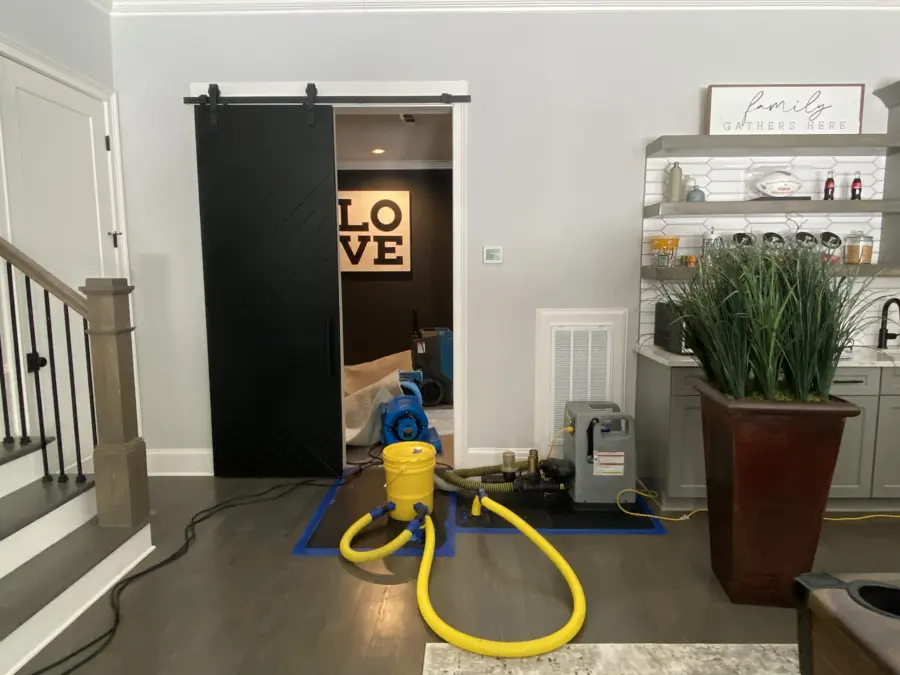
A water extraction crew starts with the discharge plan. Truck-mounted and portable units move large volumes quickly, so the crew picks where the hose ends before the pump starts.
Choosing the discharge early keeps the job within the rules and keeps the water from soaking the foundation again.
- Walk the lot to find open ground.
- Lay hoses so they do not cross walkways.
- Watch the discharge during the job.
- Move the hose end as the ground saturates.
When the water keeps coming back
A basement that refills after pumping is a sign that the source is still active: a high water table, a failed pump, a broken pipe or a blocked discharge. Pumping alone does not fix any of them.
The extraction crew looks for the source as part of the job, since drying a space that keeps refilling does not work.
- Check whether the sump pump is running.
- Look for a burst or leaking pipe.
- Check that the discharge hose is not blocked or frozen.
- Note how fast the water returns.
Floor drains and low drains
Floor drains may not be connected where they sit below the 100 year flood elevation, and a building drain too low for gravity flow must be lifted by an approved means at the owner's expense.
That makes the sump pit and any lift pump more important in a low basement. When one fails, a sump pump failure cleanup deals with the water that follows.
Hooksett's Code Enforcement office takes online applications for electrical, gas and plumbing permits, and it is also the office that keeps the flood maps on hand.
- Floor drains below the 100 year flood elevation may not connect.
- A drain too low for gravity must be lifted by an approved means.
- The owner pays for the lift.
- A failed lift pump can send water back into the basement.
The Merrimack River and the floodplain rules
The Merrimack River runs north to south through town, practically dividing it in half. The New England States Emergency Consortium reports that the spring floods of 1936 left the main street under 18 to 20 feet of water.
The Floodplain Development Ordinance applies to Zones A and AE in the FEMA Flood Insurance Study for Merrimack County dated April 19, 2010, or as amended. Under it, substantial damage means damage that would cost 50 percent or more of the structure's market value to restore.
- Zone A and Zone AE land falls under the floodplain ordinance.
- Flood maps are available at the Code Enforcement and Building Office and on the FEMA Map Service Center website.
- Substantial damage is measured against the structure's market value before the damage.
Planning before the next flood
Most discharge problems can be settled before the water arrives. A few minutes spent on the yard and the hose is easier than improvising during a flood.
- Know where the sump discharge ends and check it each fall.
- Keep a length of hose or a discharge extension for emergency pumping.
- Do not connect any basement drain to the sanitary sewer.
- Photograph the basement while it is dry.
Questions
Can pumped basement water go into the street?
The town ordinance bars placing snow, ice or pumped water on the traveled part of a public way or sidewalk without written permission.
Can a sump pump or floor drain tie into the sanitary sewer?
No. The sewer ordinances bar sending stormwater, groundwater or subsurface drainage into the sanitary sewer and bar connecting foundation drains, downspouts and floor drains to a building sewer that leads to it.
Where should the discharge hose go?
To open ground on the owner's lot, away from the foundation and not across walkways or the traveled way.
Why do crews plan the discharge before pumping?
So the water stays within the rules and does not soak back into the foundation. A basement can refill quickly if the discharge point is poorly chosen.
Does a home in a flood zone face extra rules after a flood?
The Floodplain Development Ordinance covers Zone A and Zone AE land, and substantial damage means repairs costing 50 percent or more of the structure's market value. Careful documentation of the water and the damage matters in those areas.
What if the water keeps returning after pumping?
Something is still feeding it: a high water table, a stopped pump, a broken pipe or a blocked discharge. The source has to be found before drying can work.