Structural Drying and Dehumidification in Concord, NH
Structural drying in Concord is measured, not guessed. The drying team maps moisture, sizes LGR dehumidifiers and air movers to the class of loss and keeps them running until every material reads dry.
(888) 670-6527Need a Concord home dried right? Call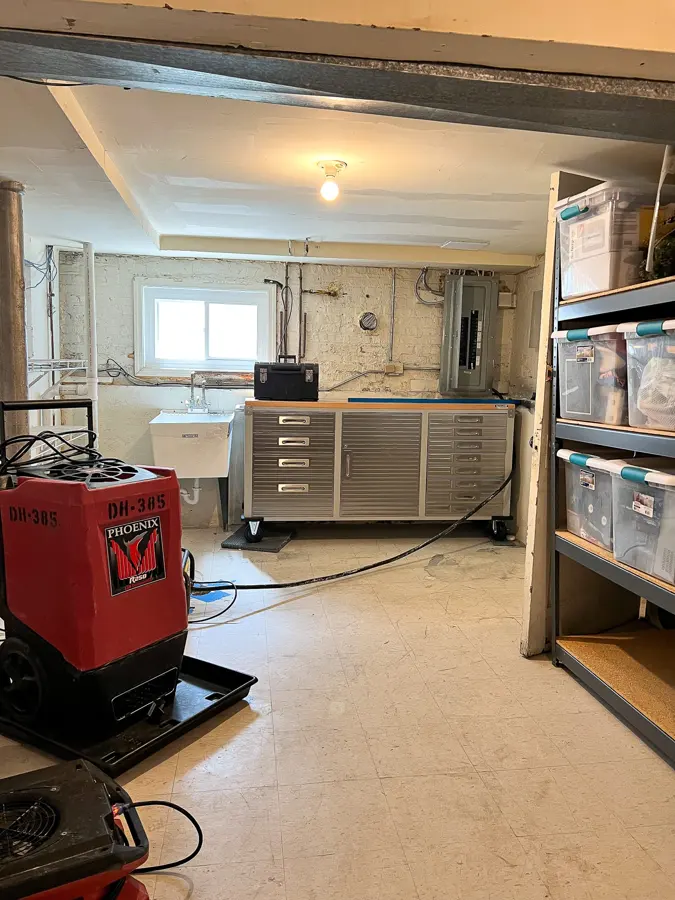
First steps for structural drying and dehumidification in Concord
Surfaces dry fast; structures do not. Framing, subfloor, plaster and masonry hold water long after a floor feels dry, and that hidden moisture is what warps floors, stains walls and lets mold start. Structural drying gets the water out of the materials themselves.
Keep the equipment running. Air movers and dehumidifiers work around the clock; switching them off at night slows the drying.
Keep doors and windows closed. The drying team sets up a controlled space; damp outside air works against the dehumidifiers.
Leave the heat as set. Warm air carries more moisture to the dehumidifiers, so keep the thermostat where the team sets it.
Stay off wet carpet floated for drying. Carpet lifted on air to dry needs to stay undisturbed until it reads dry.
Dry to the number, not the touch
A floor that feels dry can still hold enough water in the subfloor and framing to cause damage later. Readings decide when the equipment leaves.
(888) 670-6527Start the Concord drying planHow the Concord restoration team handles structural drying and dehumidification
Rapid local response
Dispatch runs around the clock, and active water is treated as urgent at any hour, weekends and holidays included.
IICRC S500 drying standard
Structural drying, not surface drying: air movers and LGR dehumidifiers sized to the class of loss, checked with daily readings.
Claim-ready documentation
Moisture maps, daily psychrometric logs and timestamped photos taken before any demolition go into the claim file.
Cold-climate know-how
Frozen pipes, ice dams, snowmelt in older stone basements and spring river flooding set how a home here gets wet.
What does structural drying and dehumidification cost in Concord, NH?
Structural drying in Concord, NH typically costs $1,200 to $7,500, set by the number of wet rooms, the class of loss and how long dense materials such as plaster and hardwood take to dry.
- A Class 1 or 2 loss
- Air movers and one dehumidifier
- Three to four days of drying
- Walls and floors across a level
- Multiple dehumidifiers
- Daily psychrometric logs
- Plaster, hardwood or concrete
- Desiccant dehumidification
- Extended monitoring
Documentation for your insurance claim
The restoration team builds the claim file: a moisture map, daily drying logs, timestamped photos before demolition and a line-item scope. A sudden pipe or appliance leak is usually a homeowners claim; rising flood water usually needs a flood policy. Coverage depends on your policy, so check with your own insurer.
Ranges are typical, not a quote: water category, square footage, material class and how fast drying started move the number most. Run the Concord water damage cost calculator for a closer range.
How structural drying and dehumidification is handled in Concord
The tech who does the walkthrough maps moisture before any equipment goes down, so the drying plan matches what is actually wet. Equipment stays until the readings say dry, not until it looks dry.
Map moisture and set the goal
Meters and thermal imaging map wet materials, and a dry reference sets the target reading.
Size the equipment
Air movers and LGR or desiccant dehumidifiers are set to the class of loss and each room's evaporation load.
Monitor daily
Readings, temperature and humidity go into psychrometric logs, and equipment is moved as areas dry.
Confirm dry
Equipment comes out when every material reads within 2 to 4 points of the dry reference.
Moisture mapping and the drying goal
The tech who does the walkthrough maps every wet material with pinless and pin-type meters and thermal imaging, and takes a reading from a dry area of the same material as the reference. The goal is to bring every wet material to within 2 to 4 points of that dry reference, the way the IICRC S500 standard measures a finished dry-out.
- Pinless meters scan large areas quickly
- Pin meters check the depth of wet framing and wood
- Thermal imaging shows where evaporation is still happening
Matching equipment to the class of loss
The class of loss sets the equipment. A Class 1 loss in one room needs little; a Class 3 loss with walls soaked high needs more air movers and dehumidification; Class 4 materials such as hardwood, plaster and concrete hold water tightly and often need desiccant dehumidifiers. LGR dehumidifiers pull water out of the air even in a cool basement, and ENERGY STAR dehumidifier information explains how dehumidifier capacity is rated.
Drying older Concord homes
Many older houses here have plaster on wood lath, wide board floors and stone foundations, which dry more slowly than drywall and plywood. Controlled heat, dehumidification and patience dry them in place more often than not. The drying team records temperature, relative humidity and grains per pound daily in psychrometric logs, which also keeps indoor air in check, as the EPA indoor air quality pages describe.
- Plaster and lath dried in place where it is sound
- Desiccants for dense materials and cold spaces
- Daily logs that show the claim adjuster the progress
Where structural drying fits
Drying follows extraction; see water extraction. For wood floors, see hardwood floor drying, and use the drying time estimator for a typical window.
Structural drying and dehumidification across Concord and Merrimack County
Concord Water Damage Restoration covers ZIP 03301, 03302, 03303 and 03305, from Downtown and Main Street and the South End out to Concord Heights, East Concord, West Concord and Penacook along the Contoocook.
Nearby coverage reaches Bow, Pembroke, Hopkinton, Hooksett, Weare, Boscawen, Loudon and Canterbury.
Related water damage services in Concord
Structural Drying and Dehumidification questions in Concord, NH
Water still spreading?
Need your home dried to a verified reading? The drying team runs 24/7.
(888) 670-6527 Call about Concord structural dryingWhat is structural drying?
Drying the materials of the building itself, such as framing, subfloor, drywall, plaster and masonry, not just the surfaces. It is measured with meters against a dry reference.
Why can't I just use fans?
Fans move air but do not remove the water from it. Without dehumidification, the moisture evaporates into the room and soaks back into other materials.
What is an LGR dehumidifier?
A low grain refrigerant dehumidifier pulls water out of air that is already fairly dry, which household units cannot do, so materials keep drying to the end.
When are desiccant dehumidifiers used?
For dense materials like hardwood, plaster and concrete, and in cold spaces where refrigerant units slow down.
How long does structural drying take?
Most losses dry in three to five days. Class 4 materials and older plaster homes can take a week or more.
Is the drying documented for insurance?
Yes. Daily psychrometric logs and moisture readings show the adjuster when and how the structure reached the dry standard.
Wet framing or plaster? Get it dried right.
Moisture mapping, LGR dehumidification and daily logs, around the clock.
(888) 670-6527Concord structural drying, 24/7