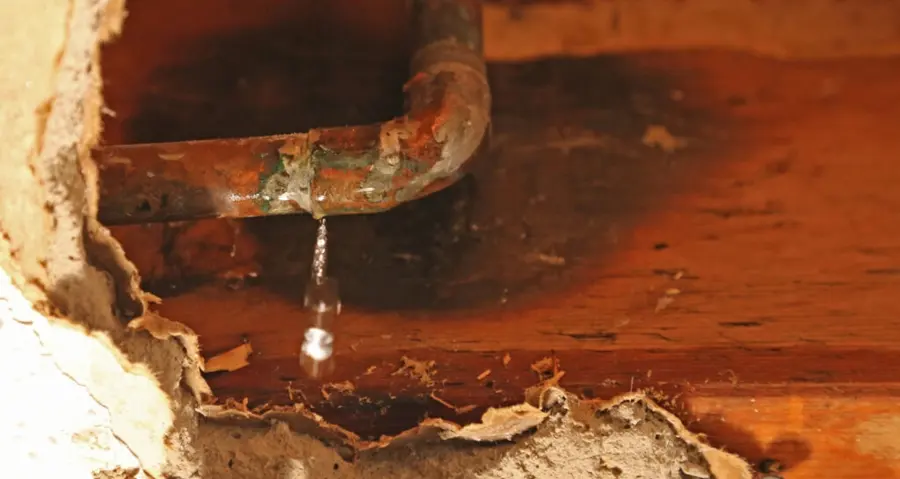
The Weare Fire Department has posted a frozen-pipes advisory after several reports of pipes bursting and causing extensive water damage in very cold weather. In a town where most homes use private wells, the plumbing that fails is the household's own.
Key takeaways
- The fire department posted a frozen-pipes advisory after several reports of pipes bursting in very cold weather.
- Around Concord, lows fall below 0 F on about 15 nights a year, and thaws bring leaks to pipes that froze earlier.
- The town has no town-wide water or sewer, so a burst pipe involves only the household plumbing and the well system.
- The first move is closing the main valve and shutting off the well pump so pressure stops.
- Wet walls, ceilings and insulation need opening and drying, since a hidden split can run for hours.
What the advisory is responding to
The fire department posted its advisory after several reports of pipes bursting and causing extensive water damage in very cold weather. The warning matches the regional climate.
Near Concord, lows fall below 0 F on about 15 nights a year, and winter thaws bring one to three days a month at 50 F or higher from December to February. A pipe can freeze and split in a cold snap, then start to leak when the weather warms.
Where pipes freeze first
Pipes tend to freeze where cold air reaches them: in exterior walls, garages, crawl areas, rooms over unheated spaces and near openings where cables or pipes enter the house.
A pipe that runs through an insulated wall can still freeze when cold air leaks around it, so a mild feeling room is not proof of a safe pipe.
- Pipes in exterior walls
- Pipes in garages and unheated rooms
- Pipes near basement windows and rim joists
- Hose bibs and outdoor faucet connections
Why a private well and septic setup matters
The town has no town-wide water or sewer system. Most residents depend on private wells and septic tanks pumped by private haulers, and the town owns only a small water system for a few town buildings in the village center along Route 114.
For a homeowner that means a burst pipe is a problem inside the house and its own pressure system. There is no town main to shut off at the street.
Because the pressure tank and well pump sit inside or beside the house, they are part of the shutoff plan.
- The main shutoff is inside the home, often near the pressure tank or where the supply enters.
- The well pump runs on household power and can keep feeding water until it is turned off.
- Waste water goes to the septic system, not a town sewer main.
- A power outage can stop the pump but not the water already in the pipes.
The first steps after a pipe bursts
Speed matters because water keeps moving downward. It soaks ceilings, runs through walls and settles into insulation and floors below.
- Close the main water valve.
- Switch off the well pump breaker so pressure drops.
- Open a low faucet to drain the pipes.
- Turn off power to wet areas only if the panel is dry and reachable.
- Move furniture, rugs and electronics out of the wet zone.
- Photograph the damage and the broken pipe.
- Call a restoration crew and a plumber.
Where the water goes
A split in an exterior wall or an unheated space can run for hours before anyone notices. Water follows framing and wiring, drips through ceilings below and soaks insulation that holds it against wood.
As of the 2000 Census, nearly 47 percent of the town's housing units were built before 1980, so many homes have older framing and finishes that take time to dry.
About 90.1 percent of the town's housing units were owner occupied for 2012 to 2016, so most burst pipes are an owner's own repair and an owner's own cleanup.
- Ceilings below a break sag and stain.
- Wall cavities hold water behind drywall.
- Insulation soaks and stays wet.
- Subfloors and hardwood absorb water from above.
- Basements receive water through the floor above.
What the restoration crew does
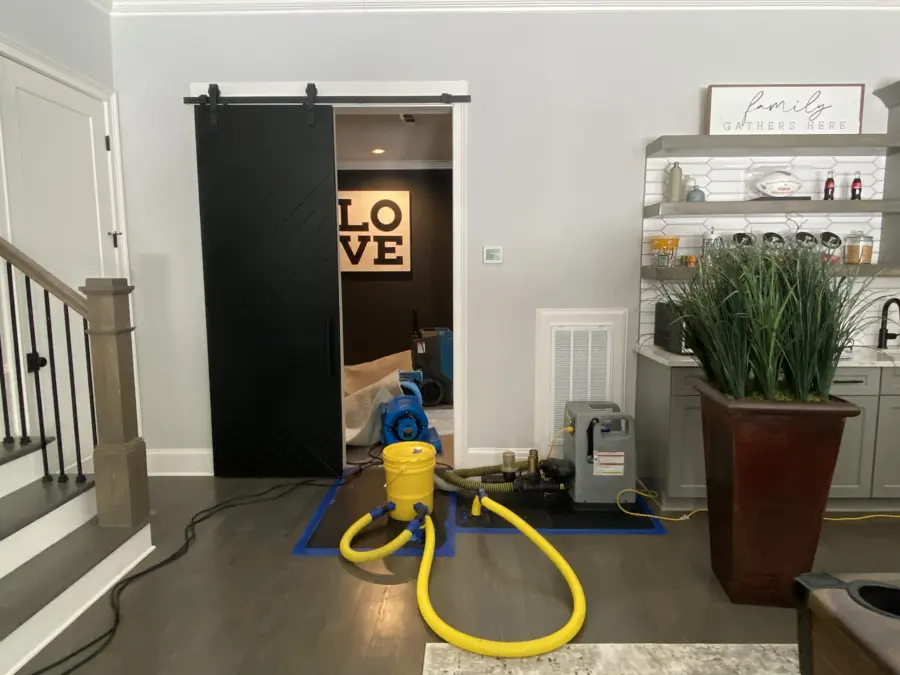
A burst pipe water damage response starts with extraction of standing water. The crew then opens wet walls and ceilings, removes saturated insulation and sets drying equipment.
A frozen pipe water damage job adds a check of other cold spots, since the first split may not be the only one.
Hardwood, laminate and carpet over the wet area are tested with a meter as well, since water travels under flooring and out of sight.
- Extraction of standing water
- Openings cut to let wet cavities dry
- Saturated insulation and soaked drywall removed
- Air movers and dehumidifiers run until readings drop
- Notes on where the pipe failed, for the plumber
After the water is out
After extraction, the drying phase can take several days. The team monitors moisture in framing and subfloors and keeps equipment running until readings are normal.
Rebuilding comes last, since closing a wall too soon traps moisture and invites mold.
Cold weather habits that help
All of the town lost power for four days in the January 1998 ice storm, so a long outage can stop the heat as well as the pump. The Weare water damage experts cover burst pipes in homes across town, and the steps match those used for any burst pipe in the area.
- Let a faucet drip on the coldest nights.
- Open cabinet doors under sinks on exterior walls.
- Keep the thermostat set when leaving for a few days.
- Insulate pipes in garages, crawl areas and unheated rooms.
- Know where the main valve and the well pump breaker are.
- Keep a plumber's contact details handy.
Empty and seasonal homes
A home that sits empty through a cold stretch carries the highest risk, since a split can run for days before anyone notices. Part-time residents and anyone leaving for a trip should plan for that.
Keeping the heat on at a safe setting, or shutting off the main valve and draining the system, are common choices, and a neighbor or caretaker checking the house adds a margin.
Questions
What did the Weare Fire Department advisory say?
It was a frozen-pipes advisory, posted after several reports of pipes bursting and causing extensive water damage in very cold weather.
Does a Weare home have a town water main to shut off?
No. The town has no town-wide water system, so the shutoff is inside the home, and the well pump power needs to be turned off too.
Why does a frozen pipe leak after the weather warms?
Ice can split a pipe while it is frozen, and the split only releases water once the ice melts and pressure returns.
Is drying needed if the leak was clean supply water?
Yes. Clean water still soaks drywall, insulation and floors, and mold can begin within 24 to 48 hours.
Should a plumber or a restoration crew be called first?
Both, side by side. A plumber repairs the pipe while a restoration crew removes the water and dries the structure.
What should be done for a house that will sit empty in winter?
Keep the heat on at a safe setting, or shut off the main valve and drain the pipes, and have someone check the house during cold stretches.