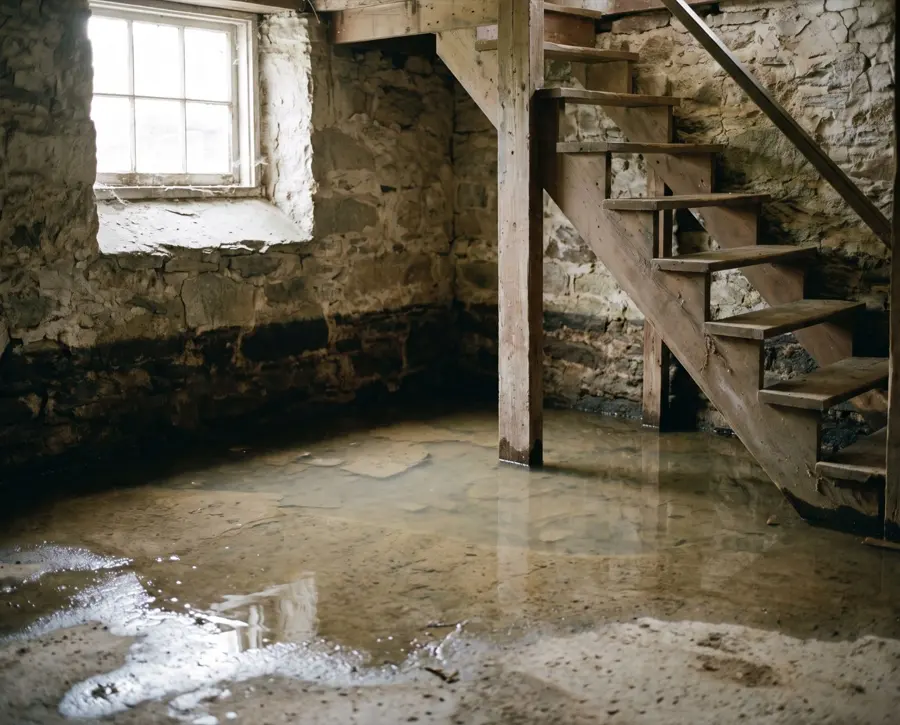
Many houses in the South End and North End were built in the 19th century, and many of them rest on stone or brick foundations. Those walls predate modern waterproofing, so when snowmelt and spring rain land on frozen ground, water often finds a way into the basement.
Key takeaways
- Older stone and brick foundations leak at mortar joints and at the seam where the wall meets the floor.
- Snowmelt and spring rain on frozen ground cannot soak in, so the water runs along the foundation and presses on the wall.
- Cleanup starts with extraction, then removal of wet materials, then controlled drying guided by moisture readings.
- Stone and brick dry slowly, so a wall that feels dry on the surface can still hold moisture.
- Photos of the wet areas and the damaged items, taken before cleanup begins, make later conversations easier.
Why 19th-century foundations take on water
Concord's housing stock is old. The median home was built about 1969, yet roughly a third of homes predate 1940, and the South End and North End hold many of the 19th-century houses.
Those houses often sit on stone or brick foundations. The walls were laid long before sealed membranes and drain tile, and they were never meant to stay perfectly dry.
Stone and brick walls
Mortar loosens over many decades, and every open joint is a small path for water. Stone faces are uneven, so water can run down the outside and push through at the lowest point.
The seam at the floor
Where an old wall meets a worn floor, a seam often runs the length of the room. Water that gets behind the wall usually shows up here first, as a dark band or a thin sheet creeping across the floor.
How snowmelt and spring rain reach the basement
The city gets roughly 60 to 70 inches of snow a year, and January brings lows in the teens with below-zero snaps. By March the ground can still be frozen while the snow above it melts.
Frozen soil cannot absorb meltwater or rain, so the water runs across the surface and settles against the foundation. As pressure builds, it works into the joints and seams.
Roof water adds to the load. Ice dams and clogged gutters can dump meltwater beside the wall instead of away from it.
- A wet corner below a downspout or a roof valley
- Water along the wall that faces the slope of the yard
- A damp floor a day or two after a warm spell has melted the snow
- Seepage around a chimney base, a bulkhead door or a window well
First steps when water is already on the floor
Safety comes before cleanup. Water near outlets, a panel or a plugged-in appliance is an electrical hazard, and an electrician or the utility should make the area safe before anyone wades in.
If the basement has a sump pit, check whether the pump is running. A pump that quit or a pit that overflowed changes the job, and it is handled as a sump pump failure cleanup.
- Stay out of standing water if it reaches outlets, the panel or a running appliance.
- Stop any source that can be stopped, such as a leaking pipe, by closing the main water shutoff.
- Lift boxes, rugs and electronics onto higher shelves.
- Photograph the room, the wet items and how high the water reached.
- Call a restoration crew before water wicks into wall bases and stored belongings.
What the cleanup involves
The first job is extraction. A water extraction crew pulls standing water with pumps and wet vacuums so it stops soaking into wood and masonry.
Next the team removes what cannot be dried, such as soaked cardboard, carpet pad and the bottom of a finished wall. The stone and brick stay in place and are cleaned and dried.
Water that comes across soil is treated as contaminated, so cleaning comes before drying.
A restoration team also sorts belongings into items that can be cleaned, dried or discarded. Cardboard boxes and soft goods that sat in water are usually discarded, while hard goods are cleaned.
- Pumps and wet vacuums remove standing water.
- Wet drywall, insulation and carpet pad are cut out and bagged.
- Floors and wall bases are cleaned and treated.
- Moisture meters map what is still wet.
Telling seepage from a pipe leak
Not every wet basement is a foundation problem. Older houses in the city also have cast iron drains, aging supply pipe and water heaters that have been in service a long time, and any of them can leave water on the floor.
The pattern helps tell them apart. Seepage tends to show along walls and corners after weather, while a pipe or tank leak tends to show near a fixture, a drain or the water heater no matter what the weather did.
- Water that appears only after rain or a thaw usually points to seepage.
- Water that appears on a dry, cold day points to a pipe, a drain or a tank.
- A wet floor around the water heater points to the tank or its fittings.
- A wet floor around a floor drain can point to a drain backing up.
Drying stone, brick and old framing
Dense masonry holds water long after the surface looks dry. A wall can feel fine to the hand while the stone behind its face is still wet.
That is why structural drying relies on readings instead of guesses. Air movers and dehumidifiers run while the team logs moisture on the wall, the wood sill and the joists, and the equipment stays until the numbers come down.
Older framing matters too. Sills and joists that rest on or against the foundation take on moisture, and mold can start to grow in 24 to 48 hours if they stay wet.
- Readings are taken on stone, wood sills and floor joists, not only on the floor.
- Dehumidifiers pull moisture from the air so it does not settle on cold walls.
- Heat helps drying but does not replace airflow.
- The team checks again after the equipment is removed.
Keeping the next thaw outside
Some habits reduce how much water reaches the wall. None of them replaces repair of a failing foundation, but they help.
- Extend gutters and downspouts well away from the foundation before the ground freezes.
- Shovel snow back from the wall where possible.
- Test the sump pump in fall and again before the spring thaw.
- Keep stored items on shelves or pallets.
- Watch the first warm days of March, when snow melts over frozen soil.
Questions
Why does a basement in an older Concord house leak mostly in spring?
Spring brings snowmelt and rain onto ground that is often still frozen. The water cannot soak in, so it presses against the foundation and finds open mortar joints and floor seams.
Is a damp stone basement normal?
Some dampness is common in older stone and brick foundations. Standing water, wet walls or a musty smell that keeps returning means water is getting in faster than the space can release it, and that is worth drying and inspecting.
How long does drying a stone basement take?
Several days is common, and dense masonry can take longer than drywall or carpet. The team keeps equipment running until moisture readings on the wall and framing come down.
Can a dehumidifier alone dry a flooded basement?
A household unit helps with humidity, but it does not remove standing water or dry wet wall bases and joists. Extraction and controlled drying come first.
Is water from outside treated differently than a pipe leak?
Yes. Water that crosses soil or comes from a river or storm drain is treated as contaminated, so cleaning and disinfecting go along with drying. A clean supply leak may need less.
When does a wet basement count as an emergency?
Standing water, water reaching outlets or the electrical panel, a pump that has quit and water that keeps coming in all count. Waiting lets moisture soak into wood and masonry, and mold can start in 24 to 48 hours.